
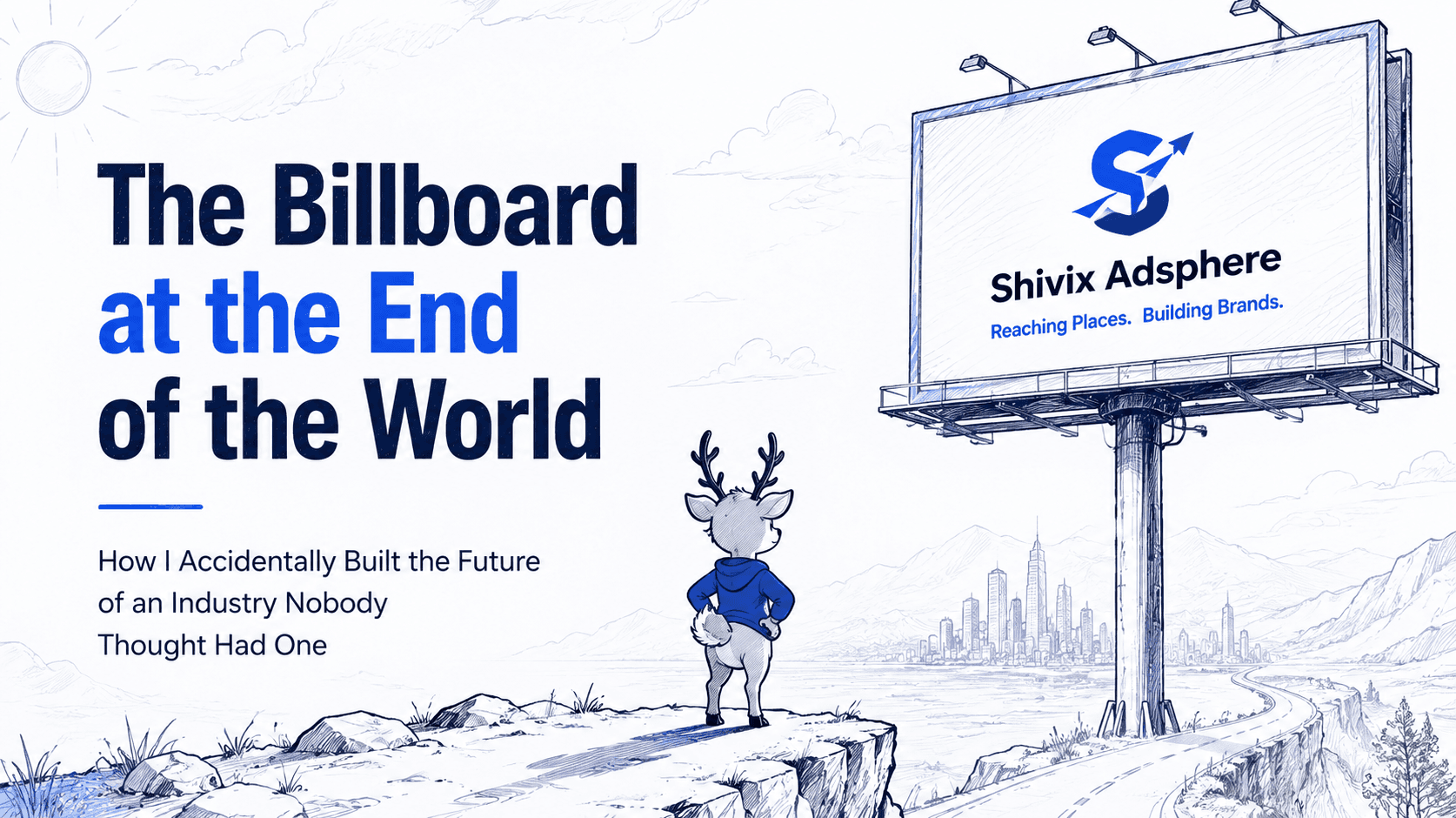
There is a billboard on the 405 in Los Angeles that nobody remembers seeing but everyone has definitely seen. It sits above the concrete like a bored god: enormous, patient, completely indifferent to whether you're late for a meeting or crying in your car or eating a burrito with one hand while merging into traffic that has no business moving at this speed. The billboard just is. It has always been there. It will always be there. And for most of my adult life, I believed, along with approximately everyone else who worked in digital marketing, that it was dying.
I was wrong about that. I am often wrong about the things I am most confident about, which is maybe the only genuinely interesting thing about me.
Growth marketing and the controlled hallucination
Let me tell you something about growth marketing that nobody in growth marketing will tell you: most of it is a controlled hallucination. You build dashboards. You run A/B tests. You optimize conversion funnels with the kind of ritualistic devotion that medieval monks reserved for illuminated manuscripts, except the monks were at least making something beautiful. You get very good at measuring things, and then you confuse measuring things with understanding things, and then, if you're not careful, you confuse understanding things with controlling things. The whole enterprise is a series of category errors dressed up in the language of science.
I came up in that world. I was good at it. I could look at a CAC-to-LTV ratio and feel something close to what I feel when I hear a chord resolve in a song. There was a rightness to it. A cleanness. And then I joined AdQuick and spent the next several years trying to apply that framework to an industry that predates the internet by about a century and a half, and the cognitive dissonance of that experience, the friction between the measurable and the immovable, taught me more about marketing, business, and the nature of human attention than any growth playbook ever did.
Out-of-home: the most honest form of advertising
I want to make an argument that will sound insane on its surface but which I believe is actually correct: out-of-home advertising is the most honest form of advertising that exists. Bear with me.
Every other ad format is, at its core, an act of intrusion. The pre-roll YouTube ad arrives uninvited. The sponsored post on Instagram disguises itself as content your friends made. The search ad positions itself as organic information. These are fundamentally deceptive architectures; they pretend to be something they are not. A billboard, on the other hand, makes no such pretense. It stands in the world and says: I am an advertisement. I am large. I am here. What are you going to do about it? There is a dignity in that honesty that the digital world abandoned sometime around 2009 and has been quietly mourning ever since without admitting it.
This is what I understood, intellectually, when I first started thinking seriously about AdQuick. What I did not understand, what took years of actual work to internalize, is that the billboard's honesty was also its perceived weakness. Because you can't click on a billboard. You couldn't pixel-track a billboard. You couldn't retarget someone who drove past a billboard at 67 miles per hour while singing along to a Tame Impala song at uncomfortable volume. The advertising industry had spent a decade training itself to believe that what cannot be measured does not exist, and by that logic, the billboard was basically a ghost. My job, in a sense, was to convince the industry it was haunted.
Building the operating system
We were building the operating system for an industry that didn't know it needed one. That's the weird thing to pitch. That's the thing that gets you the polite nod. But it's also, if you are right about the timing and right about the execution, the kind of thing that compounds into something genuinely significant.
The billboard on the 405 was never dying. It was just waiting for someone to figure out how to talk to it in a language that the rest of the advertising world could understand. That translation project, building the systems and the data infrastructure and the marketplace that lets brands and agencies treat out-of-home like a modern media channel, is what AdQuick is.
The question is whether you build something worthy
Some things are large enough and physical enough and honest enough about what they are that they simply endure. The question is never whether the billboard survives. The question is whether you build something worthy of standing next to it. I'm working on it.